


Resources / Case Study
Campaign Planning Time Cut by 90% with an Agentic Campaign System
How a leading GCC omnichannel fashion retailer turned customer data sitting in Databricks into self-serve, multilingual campaigns.

90% reduction in campaign planning time
Faster go-to-market
~10,000 analyst hours returned

Overview
A large omnichannel fashion retailer operating multiple brands across several GCC markets had the data to run precise, personalised campaigns. Millions of shopper interactions were held in Databricks, but no practical way for marketers to use it. Every campaign ran through SQL queries, fragmented tools, and cross-team handoffs.
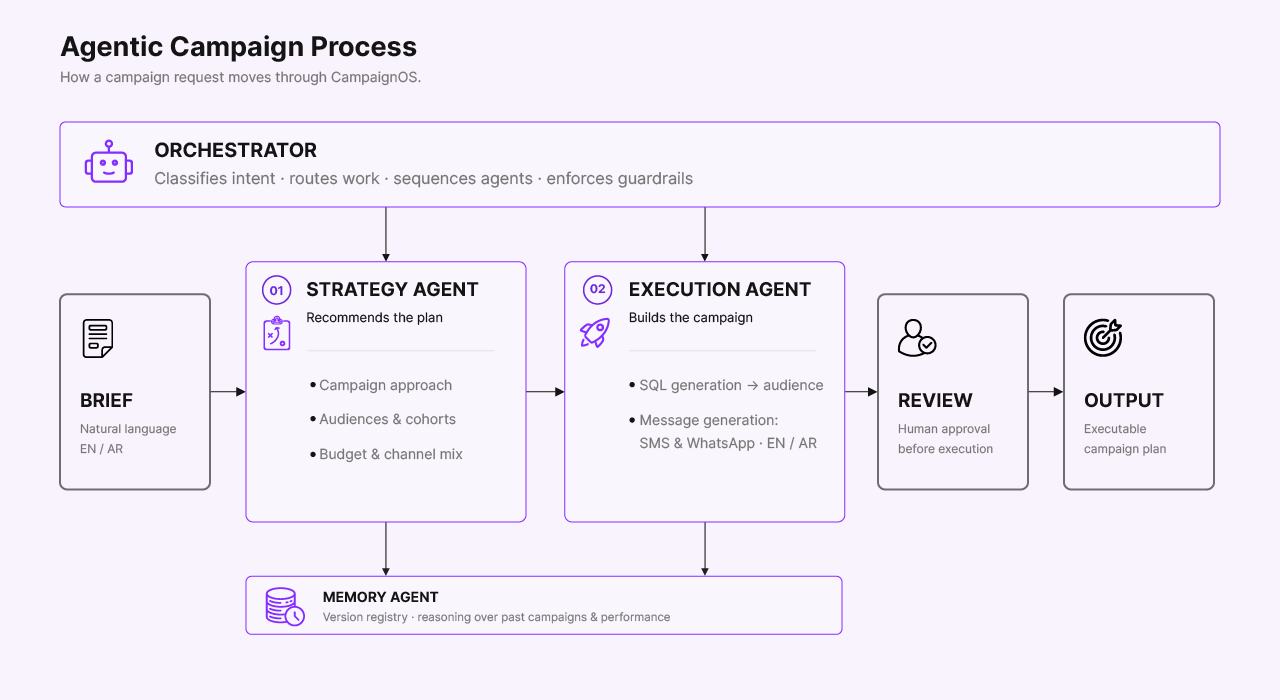
Yarnit deployed CampaignOS, an agentic campaign planning and execution system, inside the retailer's own Microsoft Azure environment. Marketers describe a campaign in plain language, in English or Arabic, and a small set of coordinated agents produces the plan: strategy, audience cohorts, budget and channel mix, the SQL that builds the actual audience, and channel-native SMS and WhatsApp messaging in both languages.

The challenge
Enterprise data the business couldn't reach without a query
The retailer's marketing organization had access to rich customer intelligence in Databricks, but activating that data into campaigns required navigating multiple technical and operational dependencies. As the business expanded across brands, markets, and channels, campaign execution became increasingly fragmented.
The retailer's marketing organization had access to rich customer intelligence in Databricks, but activating that data into campaigns required navigating multiple technical and operational dependencies. As the business expanded across brands, markets, and channels, campaign execution became increasingly fragmented.

Planning Was Distributed Across Multiple Systems
Customer data lived inside Databricks, making audience creation heavily reliant on SQL expertise. Marketers had to depend on analytics and engineering teams for customer extraction, segmentation, and campaign targeting, creating delays between insight and action.
Campaign Planning Was Distributed Across Multiple Systems
Audience selection, budget allocation, campaign strategy, content creation, and CRM execution were managed across separate tools and workflows. Teams lacked a unified environment to move from planning to execution, resulting in repeated handoffs and operational inefficiencies.
Personalization Did Not Scale Across Brands and Markets
Each brand, geography, and customer segment required unique targeting logic, messaging, and campaign configurations. Managing these variations manually made it difficult to scale personalized campaigns while maintaining consistency and governance.
Slow Execution Limited Marketing Agility
The combined impact of data dependencies, fragmented workflows, and manual campaign operations reduced the team's ability to respond quickly to business opportunities. Campaign execution became a multi-team process rather than a marketer-led function, limiting both speed and scale.
The Solution
Turning Enterprise Campaign Planning Into a Conversational AI Workflow
Yarnit deployed CampaignOS as an agentic system: a small set of specialised agents that plan and build a campaign end-to-end, coordinated by Yarnit's orchestration layer (YaOS) and grounded in a persistent memory layer (Memora). Natural language is the interface; the work is done by the agents reasoning, querying, and generating underneath.
A marketer states the goal conversationally, for example, a five-week winback for lapsed loyalty customers across the fashion brands in two markets, on SMS and WhatsApp, in English and Arabic. From there, four components do the work.

The Orchestrator classifies the request, applies guardrails, routes the work, and sequences the agents, strategy first, then execution. Every step is logged and reviewable, which is what makes the system safe to run inside an enterprise.
The Strategy Agent recommends the full plan. It sets the campaign approach from historical performance, defines and prioritises the target audiences and cohorts by reasoning across CRM segments, loyalty tiers, and brand hierarchy, and allocates the budget and channel mix across markets, including regional splits and fairness rules.
The Execution Agent turns the plan into something runnable. It generates the SQL that queries the Databricks tables, customer profiles, transactions, brand data, to build the actual audience, and it generates the channel-native messaging: SMS and WhatsApp copy, localised in English and Arabic, aligned to each cohort and offer. This is the work that previously required a SQL specialist and a separate content cycle.
The Memory Agent maintains the campaign version registry and reasons over past campaigns and performance. It carries forward what worked, what didn't, and what changed across cycles, so each new plan is informed by accumulated campaign intelligence rather than starting from scratch.
The team stays in control throughout. CampaignOS runs a human-in-the-loop workflow: marketers review, refine, and approve the strategy and the generated plan before anything executes.
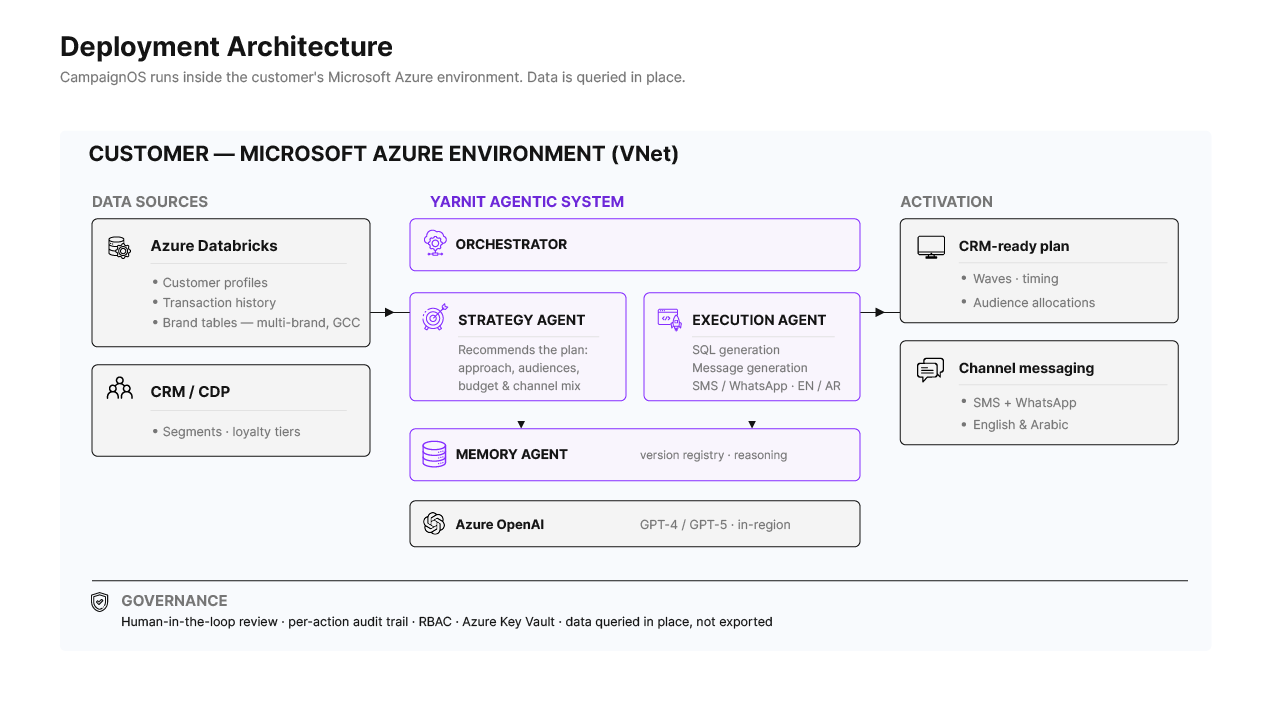
Instead of a relay across analytics, strategy, budgeting, and content teams, a marketer receives a complete, executable campaign blueprint in a single interface, and the data is queried in place, inside the retailer's own environment.
The Results
Transforming Campaign Planning Into an AI-Led Marketing Operation
CampaignOS changed how the retailer plans, optimises, and executes campaigns across its ecosystem.
90% reduction in campaign planning time
Planning cycles that ran for weeks now complete in a fraction of the time, at the same or higher quality of targeting.
Faster go-to-market
Campaigns that were gated by cross-team coordination now move from brief to execution-ready plan inside a single working session.
~10,000 analyst hours returned
The SQL extraction, manual segmentation, and query work that marketing routed through analytics and engineering is now handled by the agents, freeing technical teams from campaign-by-campaign requests.
Beyond the headline numbers, the operating model shifted. Campaign planning moved from a SQL-dependent workflow to a self-serve one any marketer can run. Segmentation, strategy, budget allocation, and multilingual messaging were unified into a single workflow. Personalised English and Arabic campaigns could be scaled consistently across brands and markets. And years of campaign history became usable in planning, through Memora, rather than re-analysed by hand each cycle.
Behind The scenes
CampaignOS runs on YaOS for orchestration and Memora for persistent context and memory, deployed within the retailer's Microsoft Azure environment using Azure OpenAI (GPT-4 / GPT-5). Customer data is queried in place in their Databricks tenant and is not exported.
Testimonial
“We were sitting on one of the richest customer datasets in regional retail, but every campaign still started with a queue for a SQL query. Yarnit's agentic system changed the operating model. My marketers now plan multilingual campaigns across our brands themselves, in a conversation, and the data is queried inside our own Azure environment. We've taken planning time down by roughly 90% and handed thousands of analyst hours back to the team. What mattered to us was that the agents are orchestrated, auditable, and that they carry forward what worked in earlier campaigns."
— VP, AI & Data Science

Check out our other case studies



Your AI Marketing Team


